Automotive supply industry
Colour stability in a plastics paint shop
A climate-controlled booth and robotic application cell that eliminated colour variation between shifts.
Otomotiv — Otobüs ve Ticari Araç
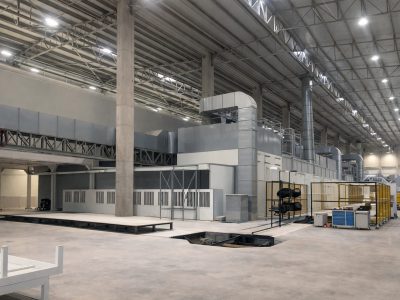
A global manufacturer of buses and commercial vehicles was relocating its finish line to a new building. Finish is the last link in bus production: touch-up paint, wax application and drying all happen here. The new building required eight separate process booths.
The real requirement, however, was not the booths. Different processes had to work in harmony, air balances had to be set correctly, energy consumption optimised, paint quality preserved and safety systems designed as a whole. Had these eight booths been split between separate contractors, the risks were clear: fluctuations in paint surface quality, production downtime, high energy consumption, commissioning problems, ATEX non-compliance — and above all, uncertainty over who is responsible when something goes wrong.
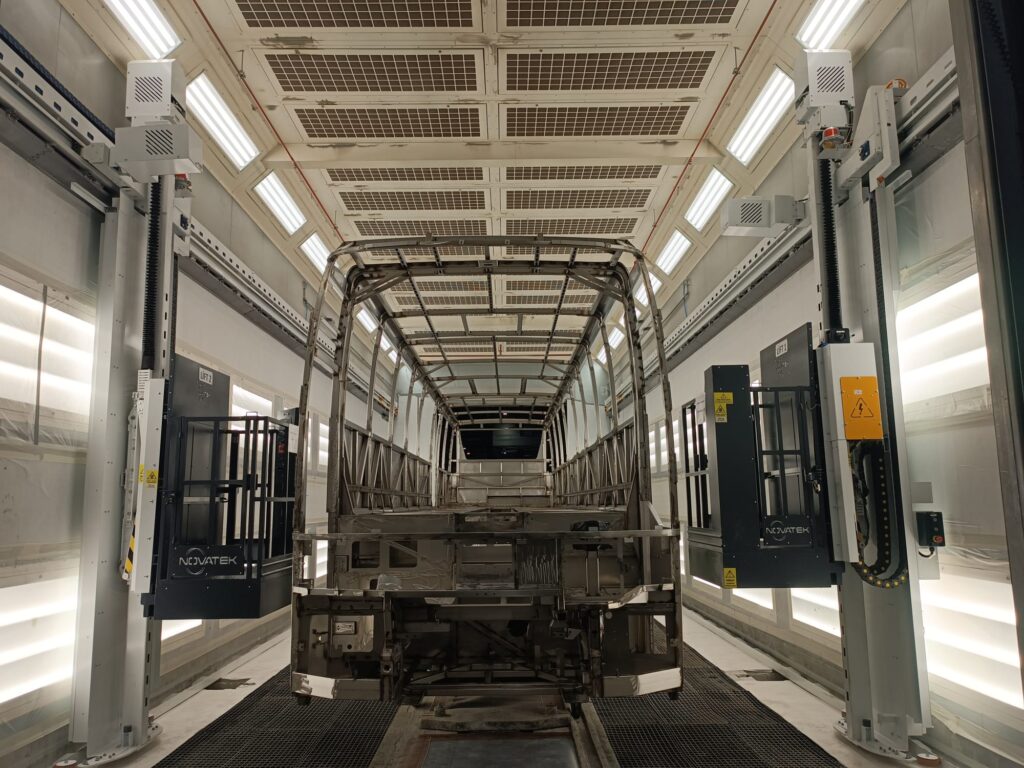
Novatek took on all eight process booths under single-contractor responsibility: process design, booth manufacturing, air handling units, filtration, heating systems, mechanical and electrical installation, automation, field instrumentation, commissioning and operator training. Hydraulic personnel lifts and infrared (IRT) drying systems were included in the scope.
Air management was the backbone of the design. The combination booth runs four separate regimes within a single enclosure, the wax drying oven recovers most of its air, and the paint booths are held at continuous positive pressure. ATEX-compliant ex-proof equipment, IE4 efficiency class motors and EN 779 / EN 1822 class filtration were used throughout.
A complete eight-booth finish line was delivered under a single engineering responsibility; the systems were commissioned, the processes ran stably and met production requirements. The customer gained a complete solution through one point of contact, lower operating costs, higher process control and simpler maintenance management.
| Industry | Automotive — buses and commercial vehicles |
| Scope | 8 process booths · turnkey |
| Booth length | 21,000 mm |
| Combination booth | 23,200 mm · 200,000 m³/h |
| Paint booth | 180,000 m³/h · 2,550 kW |
| Spot paint oven | 90,000 m³/h · 750 kW |
| Wax line | 90,000 m³/h · 1,280 kW |
| Lighting | ATEX ex-proof · min. 1000 lux |
| Motors | IE4 efficiency class |
| Filtration | EN 779 / EN 1822 |
| Acceptance | FAT · SAT · Final Acceptance |
| Responsibility | Single contractor from design to operator training |
The 23,200 mm combination booth can be split into two independent working zones by the roller door in the middle. The 5-metre section is fed by its own air handling unit at 44,000 m³/h and 15 kW; the 18-metre section at 156,000 m³/h and 55 kW.
The benefit shows up in operation: a small touch-up job does not require heating and ventilating the full 23 metres, and painting can run in one section while drying runs in the other. Building a single large volume would have been easier; operating it would have cost several times more.
The combination booth runs four separate regimes in a single enclosure: 100% fresh air and 100% exhaust during painting and flash-off, 80% recirculation with 20% fresh air during drying, and 100% fresh air again during cool-down. Transitions are automatic, via pneumatic and servo-driven dampers.
The booth is held at continuous positive pressure in every phase. Preventing dust ingress from outside is a direct determinant of paint surface quality. Painting runs at 20–25 °C and baking at an adjustable maximum of 80 °C; a safety thermostat shuts the system down at 90 °C.
The wax drying oven operates at 40 ±2 °C and reuses 90–95% of its air; against 90,000 m³/h of circulation, fresh air is only 9,000 m³/h. Recirculating heated air rather than sending it up the stack is the single largest item in natural gas consumption at this scale.
The ratio is not fixed: the fresh air share is adjustable through the automation and a modulating damper to control volatile compounds inside the booth. Hot air is supplied from underneath the vehicle and extracted from the upper zone — wax is applied to the lower and inner surfaces, so the flow starts there.
The combination booth’s exhaust line has six stages: separator filter, box filter, second separator, second box filter, paint stop mat and finally an M5 bag filter. Each stage protects the next.
The last stage is the one most often overlooked and the most expensive mistake: once contaminated air reaches the heat recovery and stack group, efficiency drops and the line has to be stopped for cleaning. The fresh air side has two stages — an M5 pre-filter and a 100 °C rated M5 ceiling filter.
Solvent-based painting places the booth and the exhaust line under explosive atmosphere classification. Ex-proof equipment was used throughout: Zone 1 ATEX certified lighting in the combination booth, Zone 2/22 class in the other booths.
This is accompanied by safety interlocks, emergency exits with panic bars opening from the inside, redundant flow monitoring that locks the process when exhaust volume falls below minimum, and safety thermostats that trip on overheating. ATEX is not a delivery document but the result of a zone assessment that must be carried out before equipment selection; without classification, no lighting, socket, fan or sensor can be specified.
A project at OEM scale is not handed over with “we built it, it runs”. Novatek verifies system performance on turnkey projects through a three-stage acceptance process aligned with international OEM practice. Every stage is tied to measurable technical criteria and recorded test reports.
Equipment is tested in our own factory before shipment: manufacturing quality, function checks, automation scenarios and conformity to the technical specification. A shortcoming is found in the workshop rather than on site — faster to correct, and incomparably cheaper.
After site installation and commissioning, the system is verified under real operating conditions: process parameters, air volumes and velocities, booth pressure, temperature curves, automation scenarios and safety functions. Every value declared at the design stage is demonstrated by measurement on site.
The handover stage at which the system is finally confirmed to meet the contract criteria, performance targets and operating requirements. From this point the plant enters the customer’s production schedule.
Novatek delivery chain: Design Manufacturing FAT Installation Commissioning SAT Final Acceptance
We have been building industrial paint shops since 2011. This project also sums up how we work: eight booths were not split between eight suppliers, and a single chain of responsibility was established from process design through to operator training.
Planning a similar line? Share your part dimensions, target capacity and paint system; our process engineer will prepare an outline concept and a budget range.
Other projects